

BIOGRAPHY
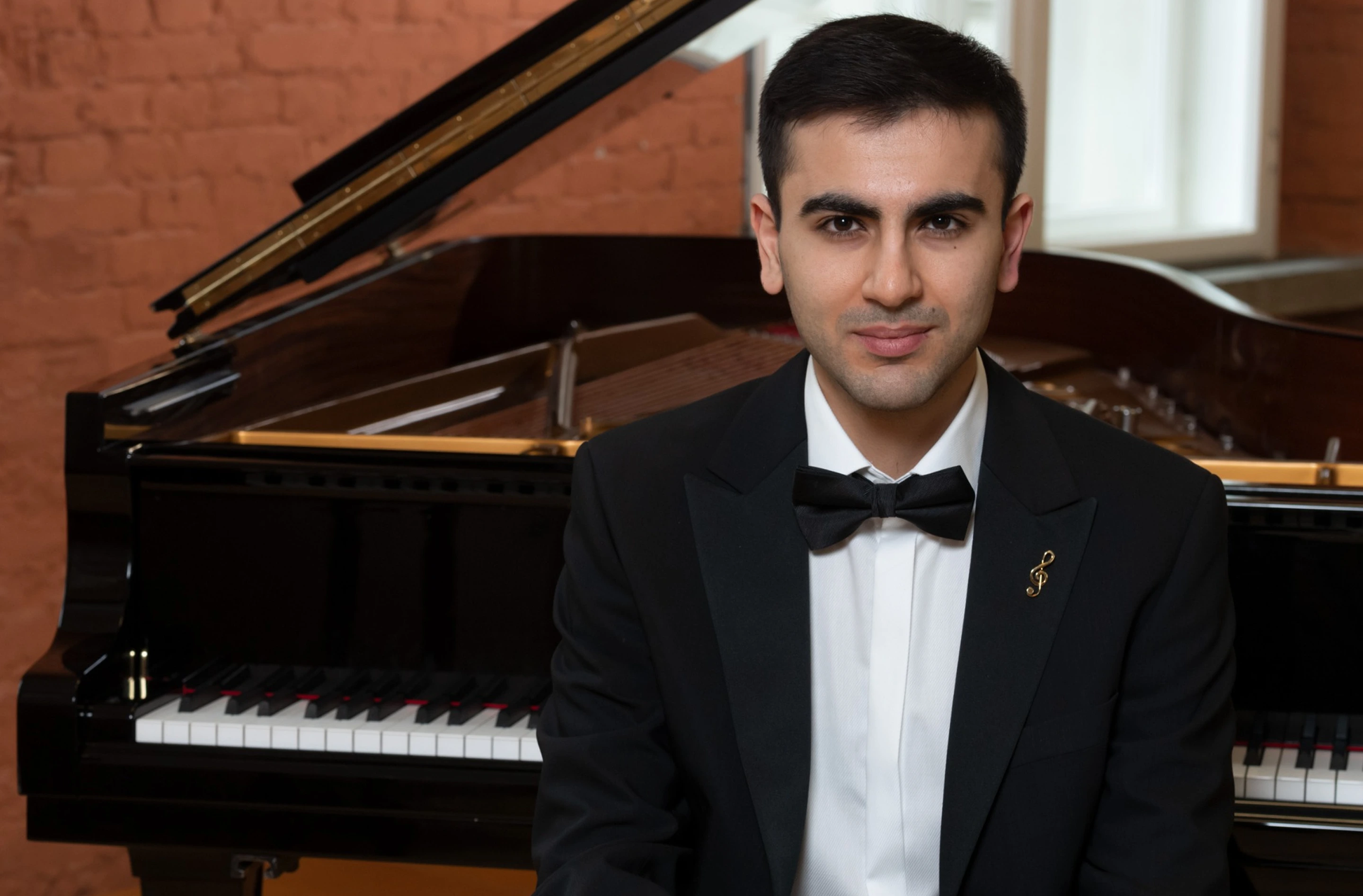
PIANIST
Beginnings and Musical Formation
Marlen Malaev was born in 1992 in Naltschik, Russia. In the early 1990s his family emigrated to Germany, where he grew up in Berlin. At the age of seven he began studying the piano with Udine Martin. In 2005 he was admitted as a junior student to the Julius Stern Institute of the Berlin University of the Arts in the class of Stefan Lietz.
Academic and Professional Development
Marlen Malaev studied at the Detmold University of Music with Prof. Hartmut Schneider and Prof. Elena Margolina Hait, where he completed his Bachelor of Music in Performance in 2017 as well as a Bachelor of Music in Piano Pedagogy in 2018.
An academic year abroad took him to the Jerusalem Academy of Music and Dance in Israel to study with Prof. Vadim Monastyrski.
In 2021 he completed his Master of Music in Performance in the class of Prof. Markus Tomas at Leipzig’s University of Music and Theatre Felix Mendelssohn Bartholdy.
At the Martin Luther University in Halle, Wittenberg he earned a Master of Arts with distinction in Piano Pedagogy under the guidance of Prof. Albrecht Hartmann. He completed the subsequent postgraduate artistic program with Prof. Hartmann in 2025, receiving the Konzertexamen degree.
Throughout his academic career Marlen Malaev was a scholarship holder of state-funded programs for the promotion of gifted students. Alongside his studies he worked as a music teacher at a secondary school in Berlin and taught at the conservatory in Halle. Since 2023, he has been living with his family in Zurich, where he leads a piano class at the Zurich Conservatory and is a member of the European Piano Teachers Association Switzerland.
Artistic Career
Marlen Malaev achieved numerous successes at national and international competitions and was awarded several first prizes. At the federal competition “Jugend musiziert” he received a first prize both as a soloist and in duo with his brother. In addition, he won first prizes as well as special prizes for the best interpretation of romantic works, including works by Franz Liszt.
Concert engagements as a soloist and duo partner have led him various concert venues, including the Philharmonie Berlin, the Deutsche Oper Berlin, the Konzerthaus Berlin, the Admiralspalast, the Rotes Rathaus Berlin and the Französischer Dom Berlin, as well as the Nicolaisaal Potsdam, the Konzerthaus Detmold and the Liederhalle Stuttgart. International appearances also brought him to the Music Center Jerusalem.
In 2017, 2020, 2021 and 2024 Marlen Malaev participated both as a soloist and chamber musician in the cultural program of the Central Council of Jews in Germany and performed throughout the country. In addition, he contributed to music recordings for German television, including film productions featuring classical repertoire.
Masterclasses and Artistic Influences
Further artistic inspiration was gained in lessons and masterclasses with Prof. Jerome Rose, Prof. Georg Sava, Prof. Begoña Uriarte, Prof. Oleg Maisenberg, Prof. Klaus Hellwig, Prof. Hortense Cartier Bresson, Prof. Konrad Elser, Prof. Matti Raekallio, Prof. Lilya Zilberstein, Prof. Bernd Götzke, Prof. Grigory Gruzman, Prof. Anatoli Ugorski, Prof. Galina Iwanzowa and Prof. Christian Petersen.
Abschlüsse auf einen Blick
Bachelor of Music Performance
Bachelor of Music Piano Pedagogy
Master of Music Performance
Master of Arts Piano Pedagogy
Concert Diploma


Künstlerisches Profil
“The piano concerto was brilliantly brought to life by the pianist Marlen Malaev. The power and beauty of the melody overwhelmed the listeners. The Larghetto became the highlight. Overwhelming passion, dense and intimate, yet at the same time shy and restrained, created sounds of a sphere like atmosphere.”
Stuttgarter Zeitung, о Втором фортепианном концерте Фредерика Шопена в Штутгартской Лидерхалле
Stuttgarter Zeitung, über das zweite Klavierkonzert von Frédéric Chopin in der Stuttgarter Liederhalle
Stuttgarter Zeitung, about the Second Piano Concerto by Frédéric Chopin at the Stuttgart Liederhalle
Formative Concert Experiences
In principle, every concert is special to me. When people give me their time and open themselves to shared listening, a moment of concentration and trust arises that I deeply value. I experience this attentiveness as both a great responsibility and a privilege.
One particularly memorable occasion was the world premiere of the arrangement of Franz Liszt’s First Piano Concerto in E flat major for piano and string quintet by Cord Garben. Liszt is one of my central artistic reference points within the Romantic repertoire, and being invited to participate in this project by Cord Garben, a multiple Grammy Award winner, was a great artistic honor for me.
Another deeply moving moment was the concert on the occasion of the 99th birthday of Margot Friedländer, a Holocaust survivor whose personality and commitment to the culture of remembrance left a lasting impression on the evening.
Unforgettable as well are performances before the President of Germany, Frank Walter Steinmeier, and his wife, as well as my orchestral debut at the Stuttgart Liederhalle with Chopin’s Piano Concerto No.2 in F minor.
Music Outreach and Interdisciplinary Projects
Beyond my concert activities, I am committed to music outreach. In one concert project, I performed Mussorgsky’s Pictures at an Exhibition, accompanied by works of the artist Robert Hehlke, who created visual counterparts to the musical images.
Music and image entered into a direct dialogue that was immediately accessible to the audience.
Chamber Music
Alongside my solo career, I devote myself intensively to chamber music. A special place is held by the duo concerts with my brother, the violinist David Malaev. Our ensemble playing is often described as devoted and interpretatively unified. Together we focus primarily on the classical and romantic duo repertoire.
In addition, I perform in a trio with David Malaev and the singer Angela Sarah Pape. In these programs we combine classical works with Yiddish and Hebrew songs, also known as Klezmer music. The particular warmth, authenticity, and cultural depth of these concerts are especially close to my heart.
Pädagogisches Profil
Моё кредо: «Научиться петь пальцами»
Mein Crédo: „Mit den Fingern singen lernen“
My credo: “Learning to sing with the fingers”


Who is your teaching intended for?
Piano instruction is offered to children, adolescents, and adults. Lessons may begin as early as four years of age. Teaching takes place in individual sessions and is tailored to the student’s age, level of development, and personal needs.
Lessons are understood as a space for genuine human encounter, shaped by respect, trust, and openness. Especially when working with children, it is important to create a learning environment in which growth can unfold without fear of mistakes. Alongside musical skills, qualities such as patience, perseverance, self-discipline, and a lasting joy in music as a life -enriching force are cultivated.
What are the fundamental goals of your piano teaching?
The piano is a percussion instrument, yet its central aim is to enable singing through the fingers. Playing the piano means making inner sound images, emotional depth, and individual musicality audible.
Since musical meaning can only be experienced through imagination, the conscious cultivation of musical imagination forms an essential part of my teaching. A convincing interpretation emerges from the interplay of tonal imagination, analytical understanding, and a physically grounded playing technique
How do you structure your lessons in practice?
Sound, technique, and physical awareness are interconnected in my teaching from the very beginning and are developed in an age-appropriate manner. Repertoire and working methods are selected individually and regularly adapted to each student’s development. I work with great attention to detail and frequently use images, metaphors, and stories to make musical relationships clear and vivid. For me, a good teacher is also a gifted storyteller who translates abstract concepts into inner images.
At the beginning, I follow a piano method for a limited period of time, usually for about six to twelve months. This phase serves to establish fundamental movements, sound imagination, and orientation on the keyboard in a secure and structured way. After that, I consciously move away from a fixed method book and select repertoire individually from the vast body of piano literature. The pieces are chosen and adapted so that they correspond precisely to the child’s developmental stage and lead forward in a musically and technically meaningful way.
An important aspect of my work is the purposeful use of modern media. During lessons, I record short videos of selected passages when needed, which serve as guidance for students and parents during home practice. These recordings allow for calm and comprehensible review of the discussed material and support a structured practice process between lessons. For me, the conscious use of digital tools is not a substitute for musical work, but a meaningful instrument for deepening and accompanying the learning process.
What role does the body play in the learning process?
Body memory plays a central role. In moments of emotional or performance related tension, both children and adults instinctively rely on what is physically anchored. Movement patterns, sound images, and musical gestures that are organized within the body remain accessible even under pressure and provide a sense of security.
This physically grounded way of working is not a preparatory step for later stages, but a fundamental component of music making itself. It facilitates the acquisition of technical skills and supports phrasing and musical expression. Technique is never an end in itself, but a means of realizing musical ideas.
How do you understand support and the development of talent?
I do not understand talent as a fixed trait, but as a potential that unfolds over time. Nurturing means developing individual learning paths, neither overwhelming nor underchallenging children, and providing them with a stable and supportive framework.
Early instruction especially requires particular care, as fundamental attitudes, sound imagination, and movement patterns are established during this phase and have a lasting influence on later playing. The aim is to recognize special dispositions and develop them thoughtfully, always maintaining a balanced relationship between challenge and individual capacity.
What experiences have your students had?
I have many years of experience working with children and adolescents on very different musical developmental paths. Students from my studio regularly take part in recitals, projects, support programs, and competitions. Some of them I accompany very closely over a longer period of time.
My students have repeatedly received prizes and distinctions, even at a young age. These results are the outcome of continuous, careful work and long term support. In addition, I guide adolescents in preparing for entrance examinations at music universities.
All of these paths share a common principle: development is not measured by individual results alone. The focus lies on musical maturity, self-confidence, and growing independence.
What is the significance of collaboration with parents?
A central responsibility of the teacher lies in assessing the child’s capacity and in guiding emotional processes. Ongoing communication with parents is therefore essential. Realistic goal setting, transparent communication, and shared reflection form the foundation of support that strengthens children and allows them to develop at their own pace. Together, we form a team.
How do you approach competition preparation?
Competition preparation is a special form of musical work and is not appropriate for every child at every stage. It requires a stable foundation in instrumental playing, joy in in-depth work, and a certain level of inner maturity. In joint conversations, we carefully consider whether and when this step is appropriate.
Preparation is a long term process and goes far beyond the weekly piano lesson. It includes regular additional meetings, a structured practice routine, and continuous guidance over an extended period of time. The goal is not short-term performance enhancement, but the development of concentration, inner security, and independence.
Competition preparation is always teamwork. Teacher, student, and parents share responsibility together.
What does piano teaching mean to you?
For me, piano teaching is always music teaching. Learning to play the piano does not primarily mean acquiring a technical skill, but developing a sense of musicality. This includes understanding musical forms, structures, and relationships, as well as the ability to hear sound inwardly and shape it consciously.
Music education must therefore be holistic and consistently oriented toward the individual personality of each student. Technique, aesthetics, and physical awareness are closely interconnected. From the very beginning, the body is consciously integrated into the learning process, since only appropriate posture, breathing, and quality of movement allow for a free, relaxed, and sustainable sound.
Different musical characters such as calm, tension, joy, or surprise are explored not only intellectually, but also physically and emotionally, so that interpretation grows out of lived experience rather than external imitation.
Do you also offer online piano lessons?
Yes, I also teach online. During the time of the pandemic, I had to find new ways of teaching and engage intensively with the online format. Out of this necessity, an independent and sustainable form of instruction has developed.
Online teaching requires a different perspective than in-person lessons. Many aspects must be described more precisely, perceived more consciously, and communicated with greater clarity. Precisely for this reason, listening skills are sharpened and the students’ self-awareness is strengthened.
I currently teach several students regularly online, including internationally. This form of instruction is no less valuable than in person teaching, but it represents a different way of working together. It is particularly well suited for in-depth musical work, long-term guidance, and for those who wish to study regardless of location.
Book a Trial Lesson
A trial lesson offers the opportunity to get to know my teaching approach in a calm and focused setting. Working together, it becomes clear how musical topics are approached and which forms of guidance are meaningful and realistic. The lesson is free-form and is disigned toward your individual background, experience, and goals.



